Getting latest data loading
X

Request a Call to Trade

In addition to the daily Research emails, I would also like to receive the Accendo Markets Weekly Newsletter and occasional Market Report emails highlighting various trading opportunities.
When you enter your telephone number, we may call or message you occasionally with trading opportunities. You can opt out at any time
Home / Education Reports / Range Trading – Lloyds, RBS

Spread bets and CFDs are complex instruments and come with a high risk of losing money rapidly due to leverage. 69% of retail investor accounts lose money when spread betting and/or trading CFDs with this provider. You should consider whether you understand how spread bets and CFDs work and whether you can afford to take the high risk of losing your money.

This report is not a personal recommendation and does not take into account your personal circumstances or appetite for risk.

Range Trading – Lloyds, RBS

Lloyds

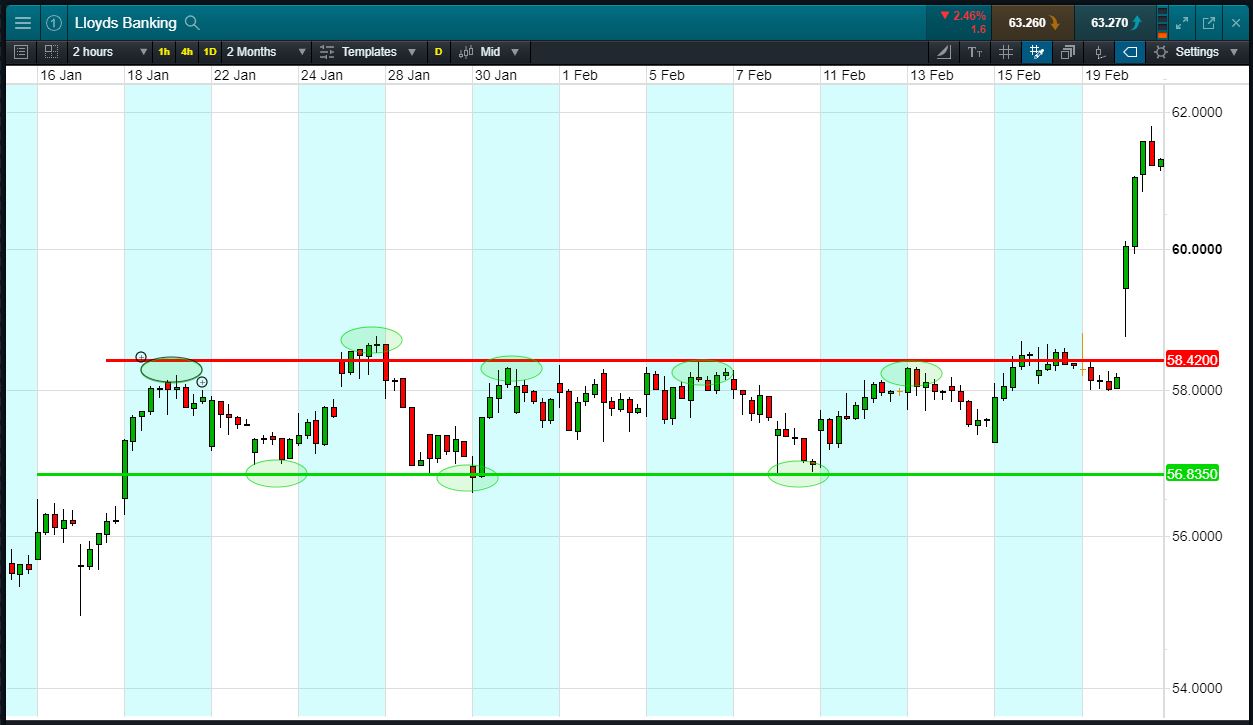
This recent chart shows how Lloyds repeatedly bounced between 56.8p and 58.4p. This is a range of 1.65p, or 2.8%*.

  • A trader might buy around 56.8p, and sell around 58.4p.
  • The intention is to hold the shares as they rise, selling before they turn down again.
  • Ranges often develop on shares like Lloyds.
  • Keep an eye on Lloyds. If a range develops again, and you see an opportunity, be ready.

Assuming a £10,000 CFD position on Lloyds, requiring a 20% deposit, correctly calling each of those 2.8% moves could have generated profits of £280 per trade. If the shares went the other way, however, losses of £280 were possible

RBS

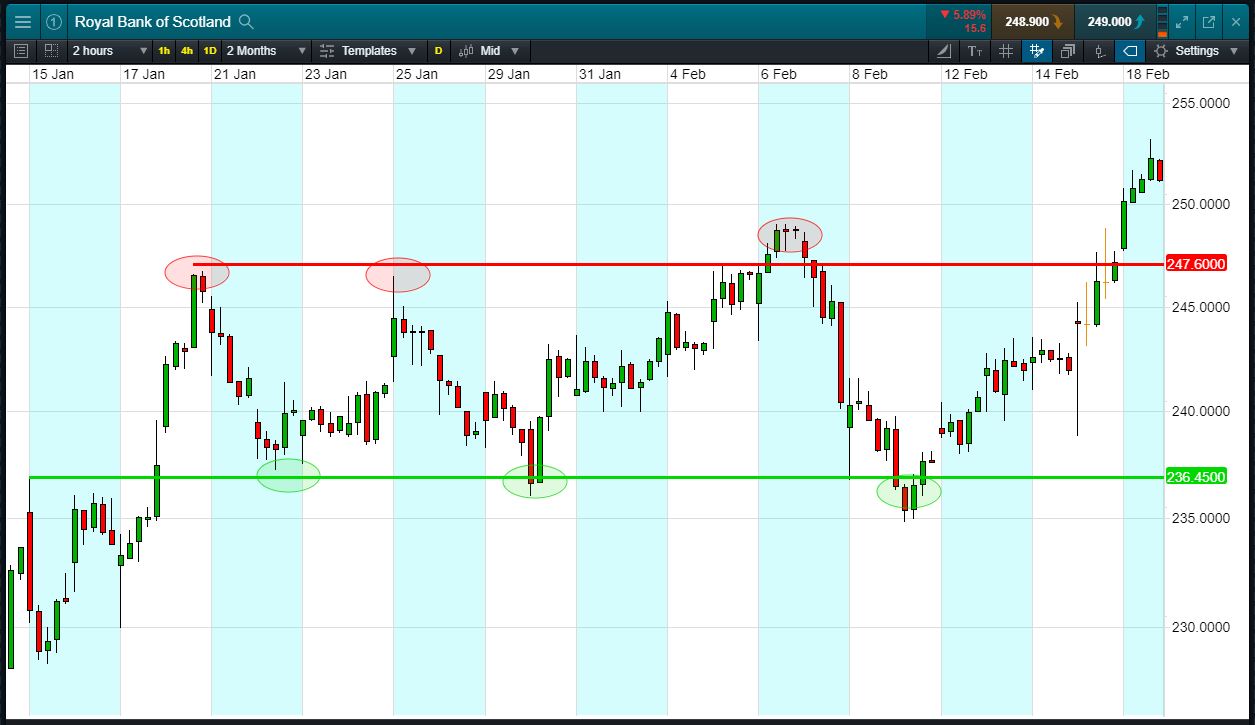
This chart shows how RBS repeatedly bounced between 236p and 247p. This is a range of 11p, or 4.6%*.

  • A trader might buy around 236p, and sell around 247p.
  • The intention is to hold the shares as they rise, selling when they turn down again.
  • Ranges often develop on shares like RBS.
  • Keep an eye on RBS. If a range like this develops again, and you see an opportunity, be ready.
Assuming a £10,000 CFD position on RBS, requiring a 20% deposit, correctly calling each of those 4.6% moves could have generated profits of £460 per trade. If the shares went the other way, however, losses of £460 were possible

trading range is a sideways channel on a chart. The shares repeatedly bounce from a zone of support and fall from a zone of resistance. Traders often use ranges to make trading decisions. Those trading UK Index Banks like Barclays, Lloyds, RBS and HSBC look for channels/ranges, assuming that the trend will continue.

*Past performance is no guarantee of the future

This research is produced by Accendo Markets Limited. Research produced and disseminated by Accendo Markets is classified as non-independent research, and is therefore a marketing communication. This investment research has not been prepared in accordance with legal requirements designed to promote its independence and it is not subject to the prohibition on dealing ahead of the dissemination of investment research. This research does not constitute a personal recommendation or offer to enter into a transaction or an investment, and is produced and distributed for information purposes only.


Accendo Markets considers opinions and information contained within the research to be valid when published, and gives no warranty as to the investments referred to in this material. The income from the investments referred to may go down as well as up, and investors may realise losses on investments. The past performance of a particular investment is not necessarily a guide to its future performance.

Spread bets and CFDs are complex instruments and come with a high risk of losing money rapidly due to leverage.
Spread bets and CFDs are complex instruments and come with a high risk of losing money rapidly due to leverage. 69% of retail investor accounts lose money when spread betting and/or trading CFDs with this provider. You should consider whether you understand how spread bets and CFDs work and whether you can afford to take the high risk of losing your money.
.